There Are No Unique Ideas After All — Am I Already Too Late?
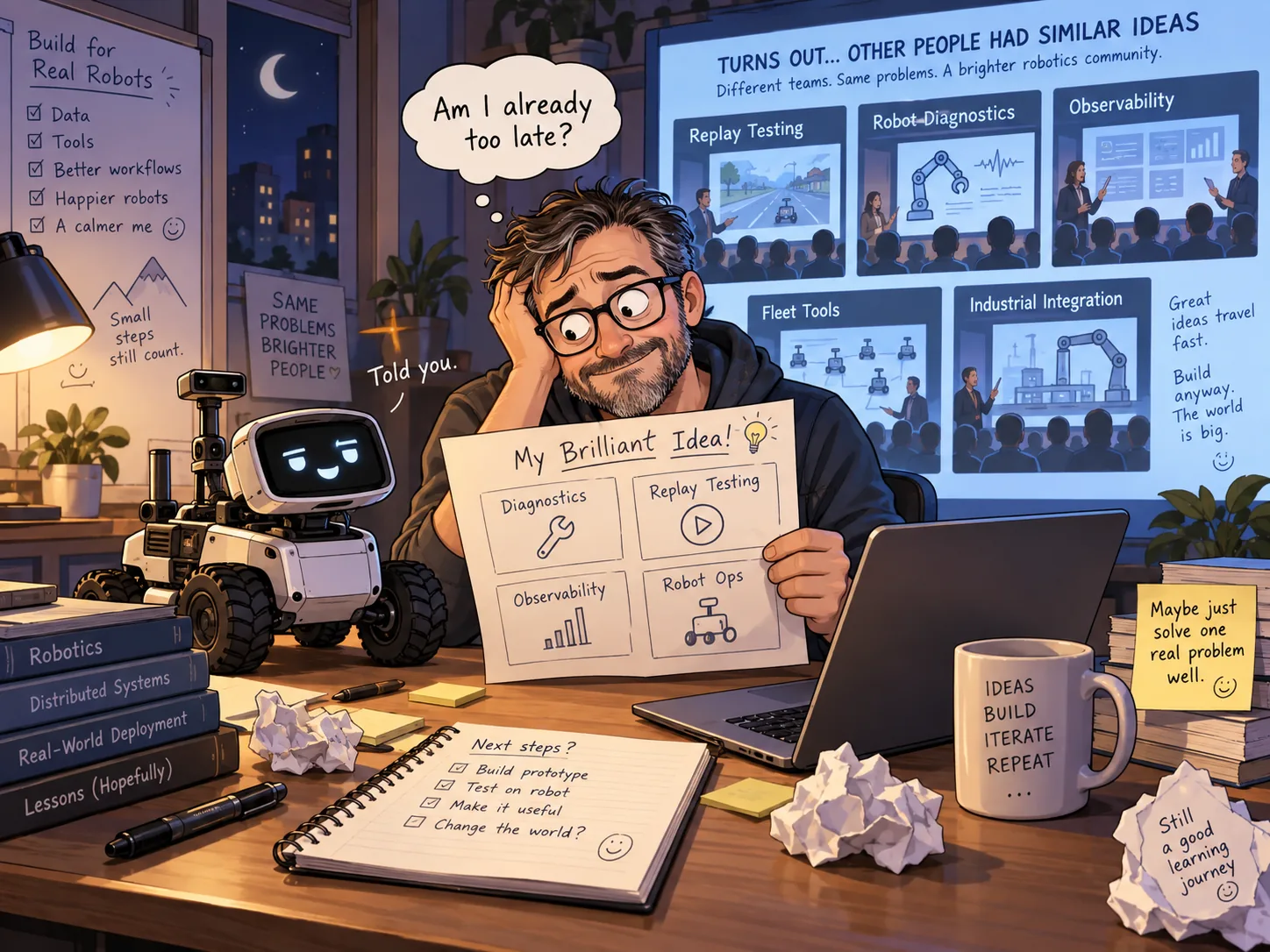
My brilliant idea, apparently already discussed by half the robotics world.
When my small development robot, the M3 Pro, misbehaved, my software-systems instincts kicked in. If a sensor stream went quiet, how would I tell whether the sensor failed, ROS stopped delivering messages, a transform disappeared, or an application simply stopped listening?
I wanted the robot to save the evidence before anyone rebooted it. Then I could replay the same inputs on my workstation, change the software, and see whether the failure returned.
My brain quickly leapt from diagnostics to observability, automated tests, remote deployment, and eventually a RobotOps platform. A polished architecture diagram was probably minutes away.
Then I started watching ROSCon.
Ah. Everyone Is Already Here
Other people were already working on replay testing, robot diagnostics, observability, fleet tools, and industrial ROS integration. Some had years of production experience and many more robots than I did.
I have spent more than twenty years building software systems, but I am still new to robotics. For a moment the obvious question was: Am I already too late?
The surprise became useful after I thought about it. Existing tools are evidence that the underlying problems are real. Reproducing failures, understanding what happened on a deployed robot, and connecting robotics software to existing infrastructure are difficult enough that people keep working on them.
If nobody else wanted animated weather widgets on robot dashboards, originality would not be much comfort. Independent teams building replay tests and health tools are a stronger signal. They do not prove that every failure mode has been solved, or tell me which part hurts most on my M3 Pro.
So the better question is: Which part still hurts, and can I show that I solved it?
My Platform Reflex
I know this pattern from software engineering: find repeated operational pain, abstract it, add telemetry and automation, and give the result a platform name. Those instincts can be useful. They can also produce a beautiful dashboard before they produce one verified fix.
I could add CPU, camera, LiDAR, and battery indicators to the M3 Pro. I could ask AI to help sketch the interface and write the first version. None of that would tell me why a sensor stream had stopped or whether a repair would survive the next run.
The world probably does not need another generic robot dashboard from me. I would rather use the existing tools and my own experience to close one failure from beginning to end.
AI makes it easier to sketch a demo or an architecture. The harder question is whether any of it helps explain what happened on a machine with sensors, motors, and an unreliable connection to the rest of the world.
One Failure, With AI in the Loop
Imagine a sensor stream becomes stale while the rest of the system still reports that the robot is healthy. The first task is to capture enough evidence to ask precise questions: a focused ROS bag or MCAP recording, timestamps, relevant logs, the ROS graph and transforms, configuration, and software versions. My last Wi-Fi debugging session taught me what happens when the useful logs disappear after a reboot.
Then I want to try something I have not yet tested on my robot: give an AI assistant a reviewed, bounded view of that evidence and ask for competing explanations. Did the publisher stop? Did messages stop arriving? Was a transform missing? Did the application reject data with stale timestamps?
I would start with a short time window, selected topic statistics and plots, and the relevant log lines instead of hours of raw camera data. I want the assistant to identify which observations support each suggestion and which measurements are missing. Any test it drafts should run against recorded data first.
The useful output would be a small test plan: what observation would distinguish those possibilities, which part of the recording to replay, and what result would falsify each hypothesis. Research on analyzing ROS bags with language models shows that this direction is being explored. It does not establish that an assistant will correctly diagnose my M3 Pro.
I can measure whether AI helps me reach a reproducible test faster, or whether it sends me down a convincing but wrong path. Either result is worth recording.
The test itself has to be repeatable. Replay the same input, reproduce the software failure, make a fix, and replay it again. Then check the relevant behavior on the actual robot. A recording can reproduce part of the software environment; it cannot recreate every physical response to a new motor command.
A clean replay result is not the final answer. Timing, power, motion, and the environment may matter on the physical machine. If the failure disappears only in replay, that gap is evidence I need to explain before calling it fixed.
My milestone is deliberately narrow:
One real failure. One recording. One AI-assisted set of hypotheses. One test that fails before the fix and passes after it. One final check on the robot.
If another engineer can reproduce the software portion without owning my exact robot, even better.
The recording, software version, configuration, and test should make that possible. Another engineer ought to be able to challenge my conclusion, including any suggestion from AI, using the same evidence.
What My Previous Experience Can Contribute
I did not spend my career writing control algorithms or building manipulators. I worked on distributed software, data, APIs, testing, deployment, and production failures.
That experience gives me useful habits: save evidence, version configurations, reproduce incidents, and distrust a fix that only worked once. Robotics adds timing, calibration, imperfect sensors, unreliable networks, physical consequences, and safety constraints. I need to learn where my familiar methods still work and where the physical world demands something different.
AI may help me search the evidence and propose the next experiment. The recording, the repeatable test, and the robot will show what actually happened.
So, Am I Too Late?
To be the first person to suggest monitoring robots? Absolutely.
To find a real, specific failure and solve it carefully? I do not think so.
The next step is to earn some depth, not invent another category. I want to take one problem from observation to a recorded failure, a tested fix, and documentation another engineer can use. I also want to find out whether AI genuinely improves that investigation, including the moments when its suggestions are wrong.
Someone has probably thought of this too.
That's fine.
Now I have to do it.