First Day with the Robot
The robot—an M3 Pro—arrived on August 25, 2026.
The first impression was mixed in a useful way: there was a lot of capability in the platform, but it was immediately clear that this was closer to an engineering/development kit than a polished consumer robot.
The remaining assembly and inspection work forced me into details I had not needed to think about while comparing specifications online.
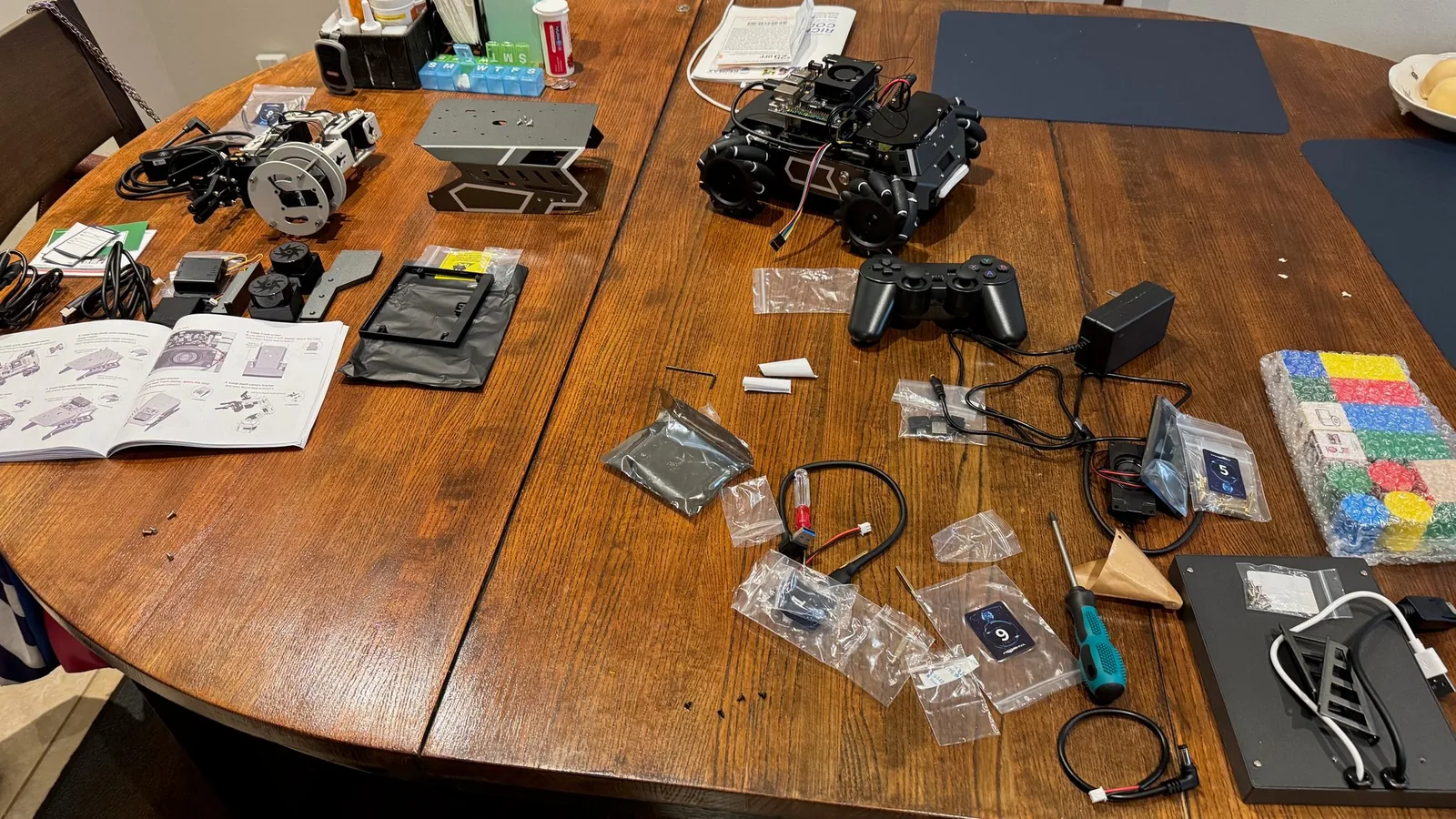
Assembly day: the robot spread across the dining table with the base, arm, display hardware, cables, tools, and documentation still being sorted out.
I worked through questions around:
- antenna installation and mounting hardware
- OLED/display wiring
- battery and controller connections
- an additional battery connector whose purpose was not initially obvious
- remaining parts that were difficult to identify from the documentation
- the LCD, which appeared mechanically misaligned or imperfectly installed
The robot my wife expected
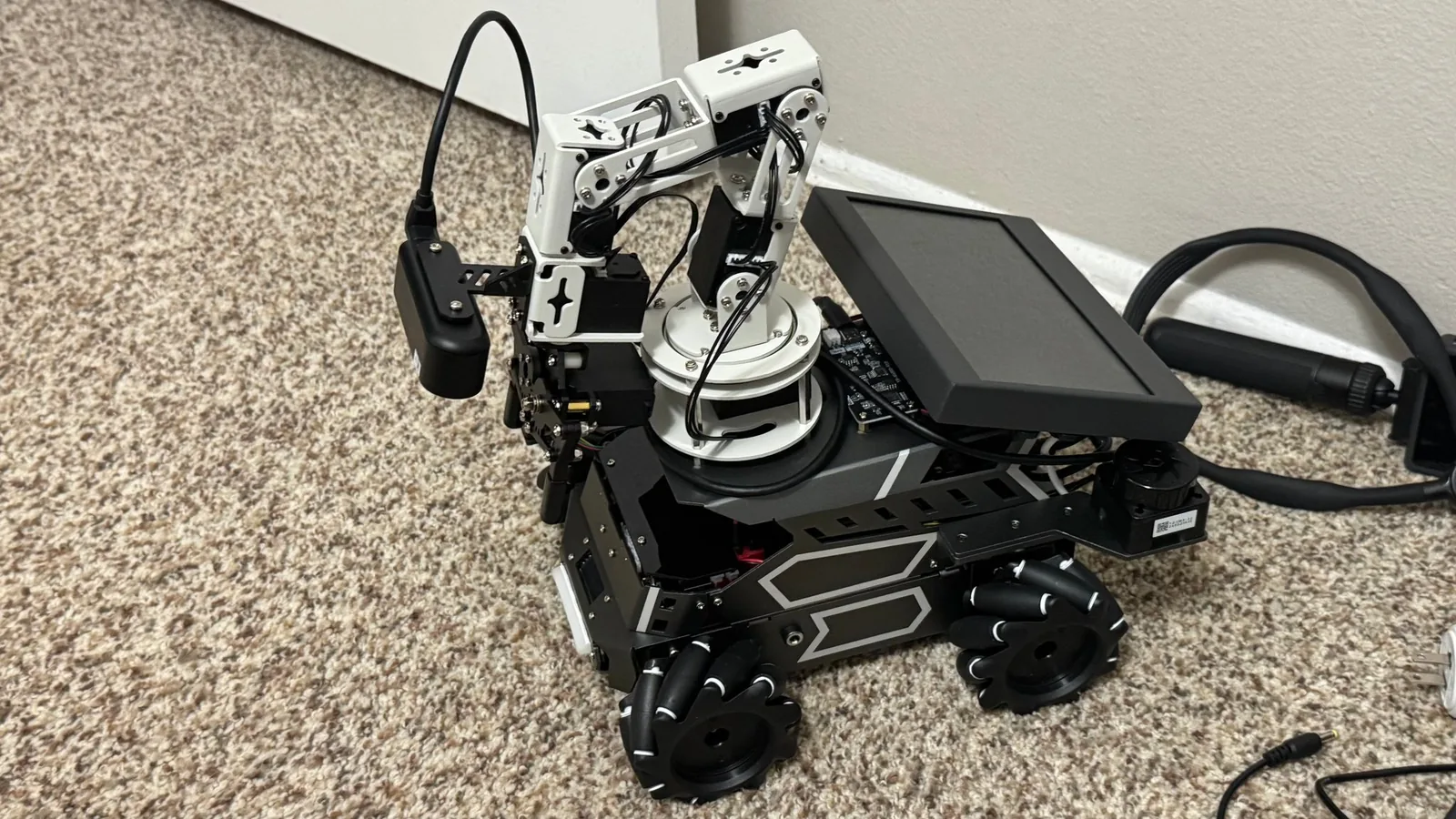
The assembled robot. Capable as a development platform, but visually much smaller than the robot my wife had imagined for the price.
Assembly took longer than I expected, so when the robot was finally standing there in one piece, I was fairly satisfied just to see it assembled.
My wife looked at it and had a different first reaction:
"Huh? It's kind of tiny. Isn't it too small for what it cost? Can it even do something useful like cleaning?"
I laughed because I realized we had been carrying very different pictures of the word robot.
I had bought a robotics development platform.
In her head, I suspect a nearly $3,000 robot was supposed to be at least somewhere on the road toward Tesla Optimus.
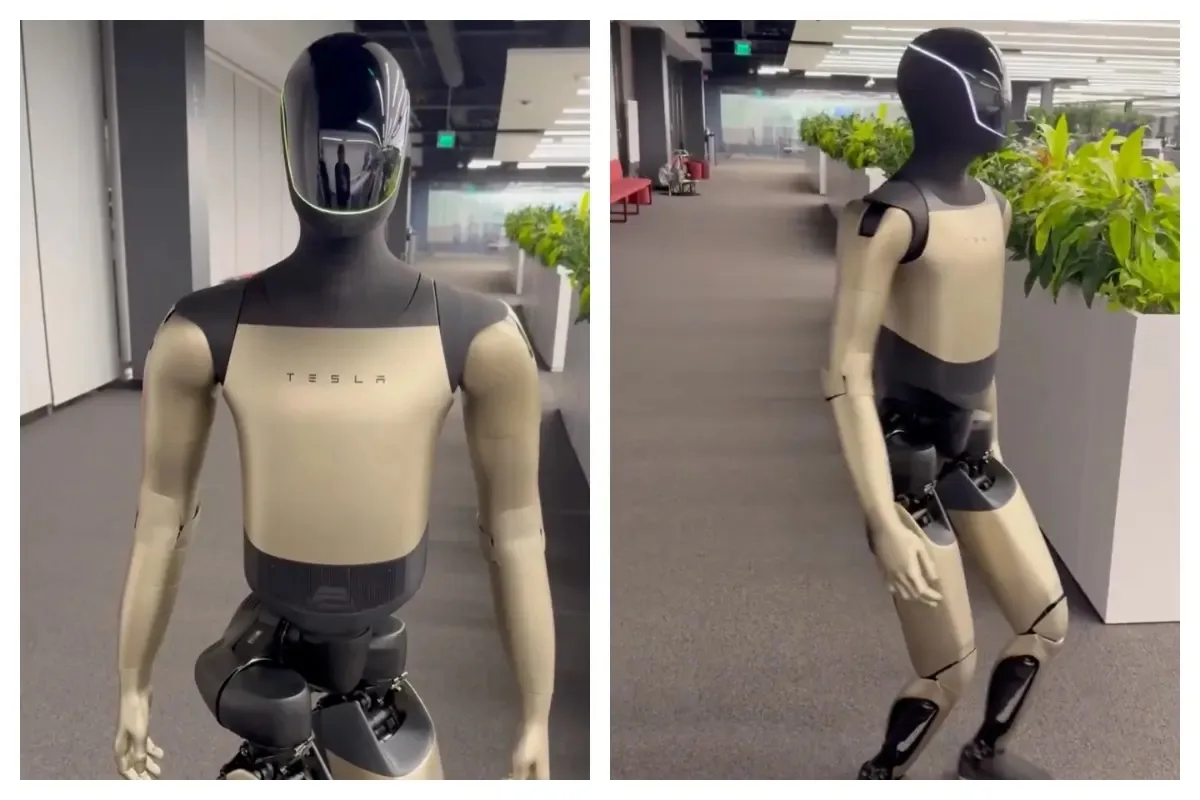
The other mental model of “robot”: Tesla Optimus. Third-party reference image included only for visual comparison.
Her reaction immediately sent me back to the market. I started searching for something closer to what she had imagined: a taller mobile platform, roughly human working height, with two reasonably precise arms.
The gap was surprisingly obvious.
The more convincing systems I found quickly moved into prices above roughly $10,000. At the affordable end, there were platforms using Raspberry Pi-class compute and inexpensive arms whose payload, reach, repeatability, or overall mechanical precision looked much more limited.
What I wanted seemed to sit awkwardly in the middle:
small education / hobby robots
        |
        |   large gap
        v
useful mobile manipulator
- good vision
- two reasonably precise arms
- useful payload
- vertical reach around human work surfaces
- ROS 2 programmability
        |
        v
expensive research / commercial systems
That gap itself is interesting.
A useful household robot may not need legs yet. Walking humanoids are still mechanically complicated and expensive. A wheeled base can already move efficiently through many indoor environments.
Give that base good perception, suitable actuators, and arms that can move vertically through roughly the same working range humans use for tables, counters, shelves, appliances, and other household objects, and the result could already be surprisingly useful.
Programming such a machine is another problem entirely.
For the kind of platform I want to experiment with, ROS 2 access matters because I do not just want a robot that performs fixed vendor behaviors. I want to inspect, integrate, modify, and eventually replace parts of the software stack.
At the same time, I can understand why robotics startups cannot simply open every part of their system. Their control software, calibration, perception stack, mechanical design, and integration work may be exactly where their competitive advantage lives. They also have to turn an interesting robot into a sustainable company.
That creates an interesting tension for someone like me:
I want increasingly capable robots to become programmable platforms, while the companies building them need enough proprietary value to survive and grow.
Maybe the missing middle will not stay missing for very long.
If demand grows for capable mobile manipulators below full humanoid cost, I would expect a lot more companies to try to fill that space.
For now, though, the M3 Pro is small enough that my wife's reaction was fair—and complex enough that I already have plenty to learn from it.
None of the assembly issues was individually dramatic. Together, they produced the first real lesson of owning the robot:
Robotics starts below ROS.
The software stack depends on a physical stack that includes batteries, connectors, controllers, sensors, USB/serial links, mechanics, and power distribution. A problem lower in that stack can make everything above it irrelevant.
A change in perspective
Before delivery, I mostly imagined learning ROS 2, navigation, perception, and manipulation.
On arrival day I found myself asking questions like:
- Is this cable connected correctly?
- What is this unused connector for?
- Is this display installed incorrectly?
- Which part of the power system am I actually looking at?
That did not feel like a detour from Physical AI. It started to look like the point of buying real hardware.
A polished robot might have hidden many of these details. The M3 Pro was already making the physical world argue with my software assumptions.